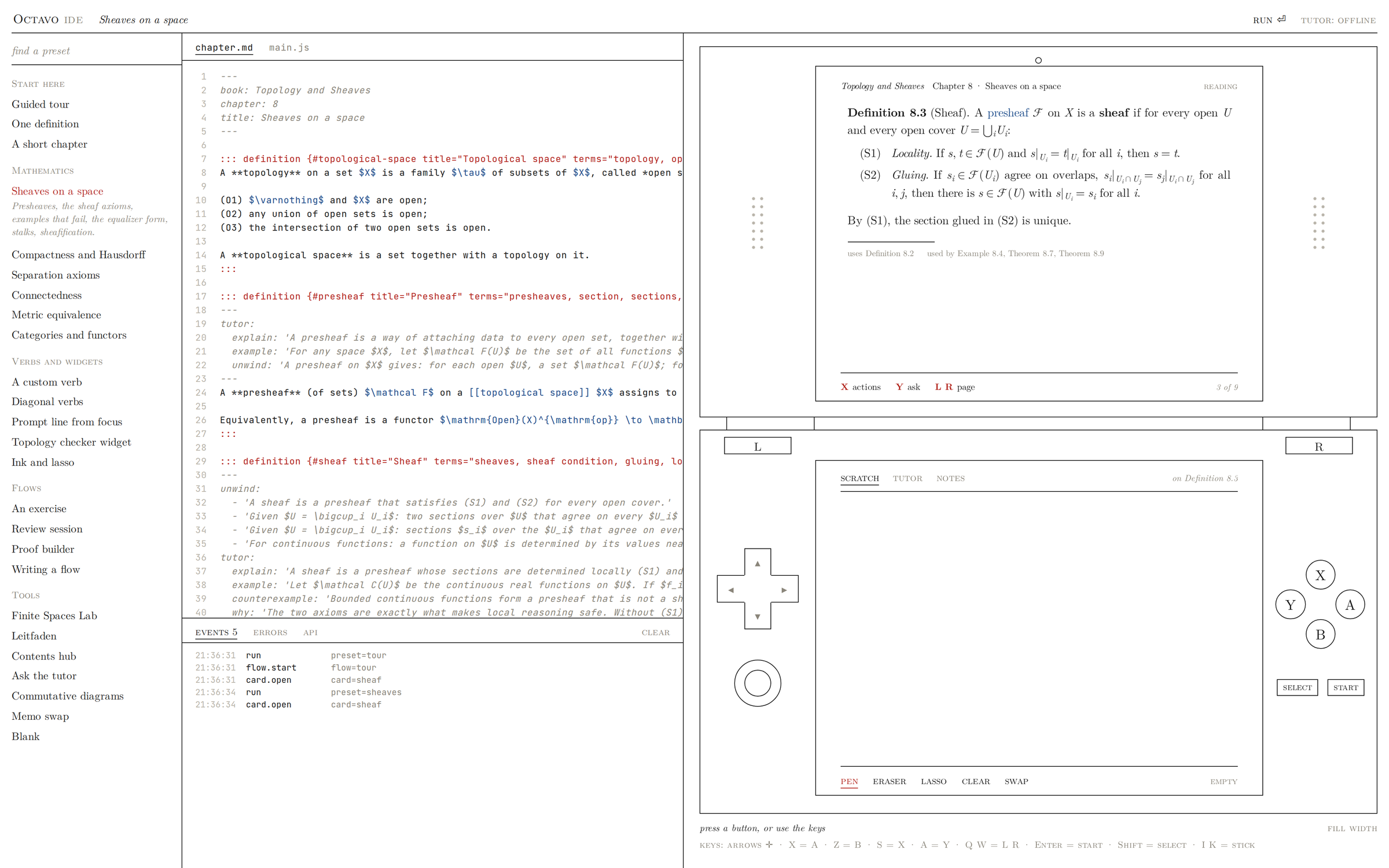
Octavo IDE
An IDE for mathematics chapters on a two-screen handheld: write cards in Markdown and TeX, script verbs and flows, and read, peek, map and practise on the device beside the editor.
In early access for subscribers until 22 November 2026. Subscribe to run it now.
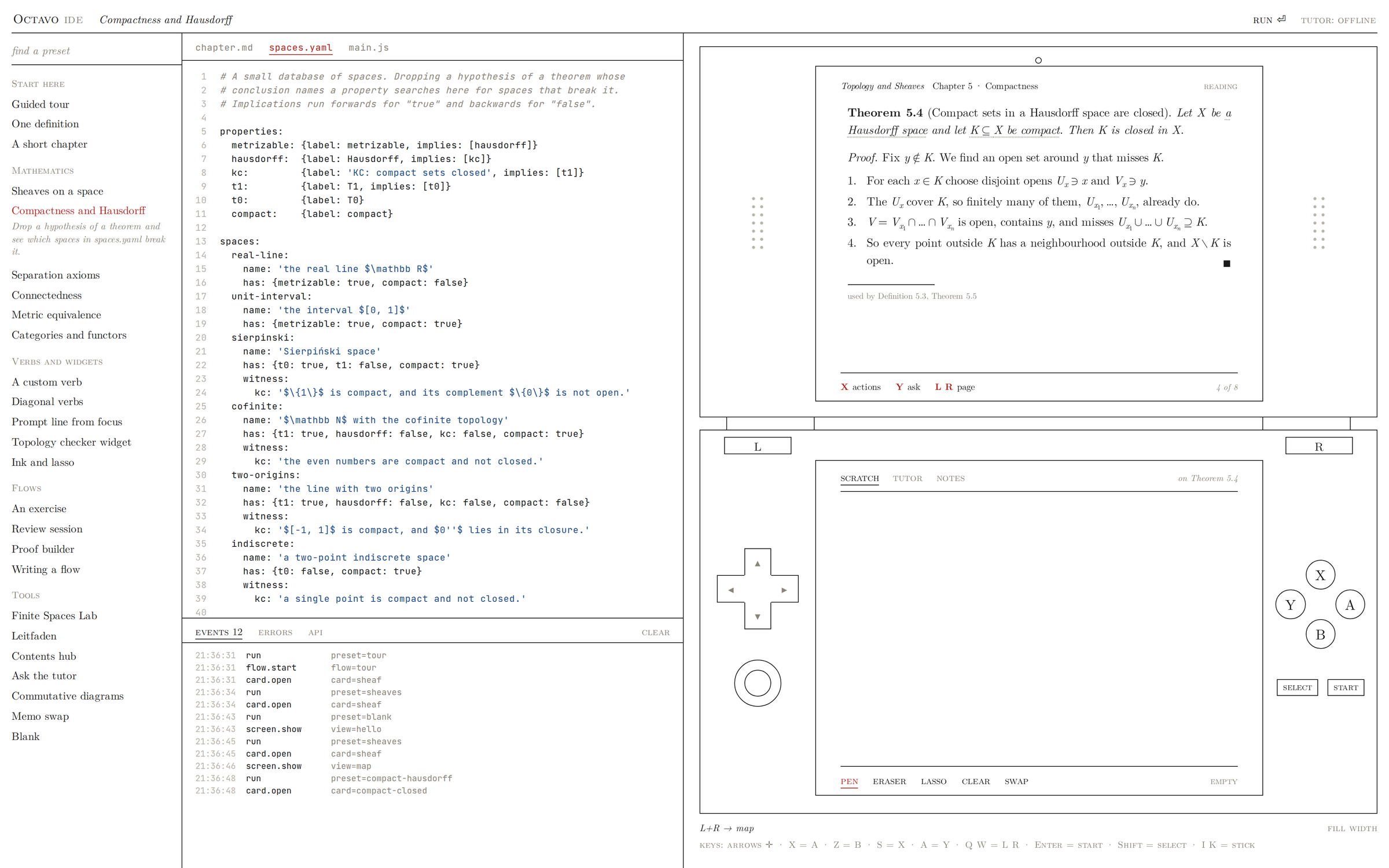
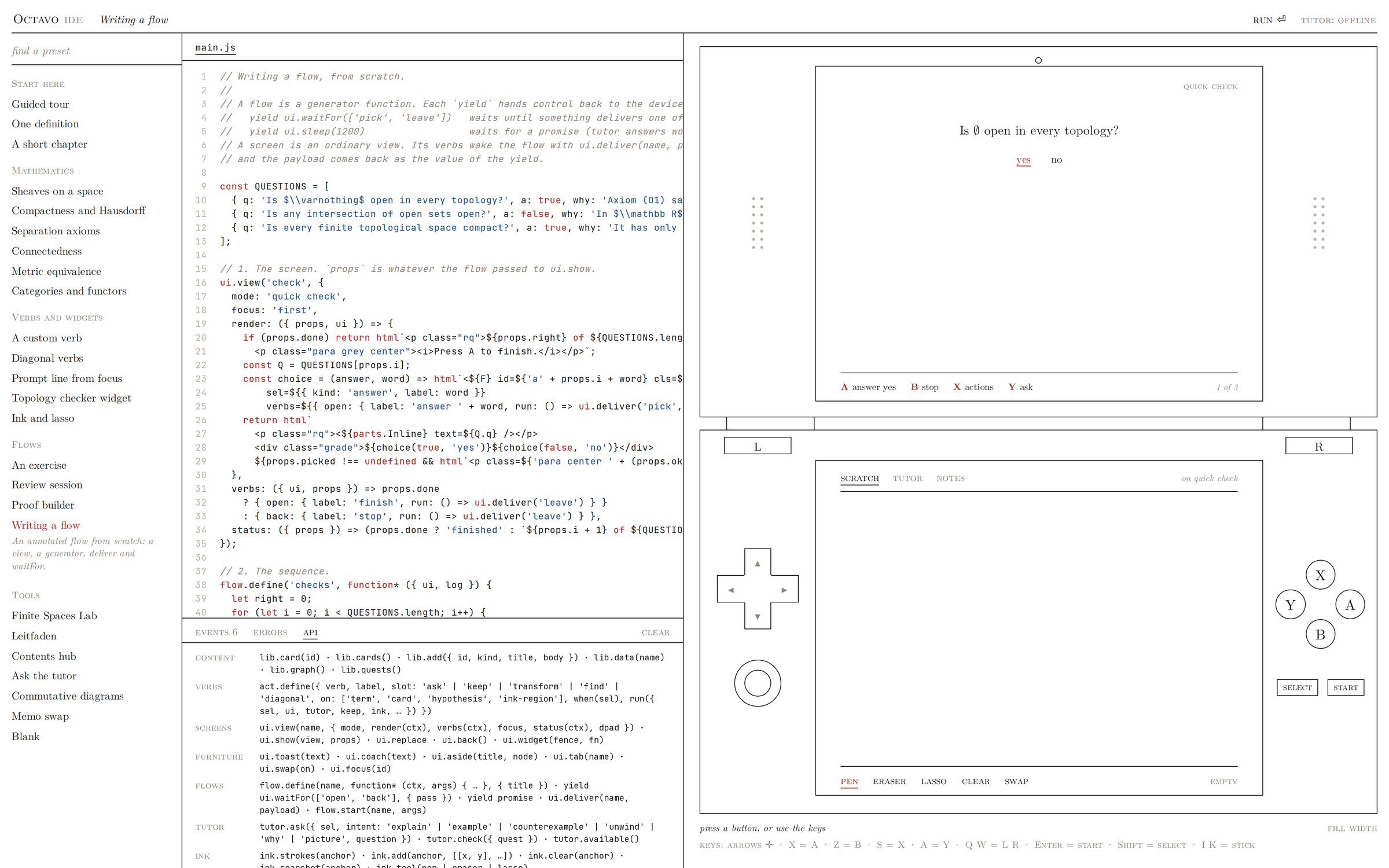
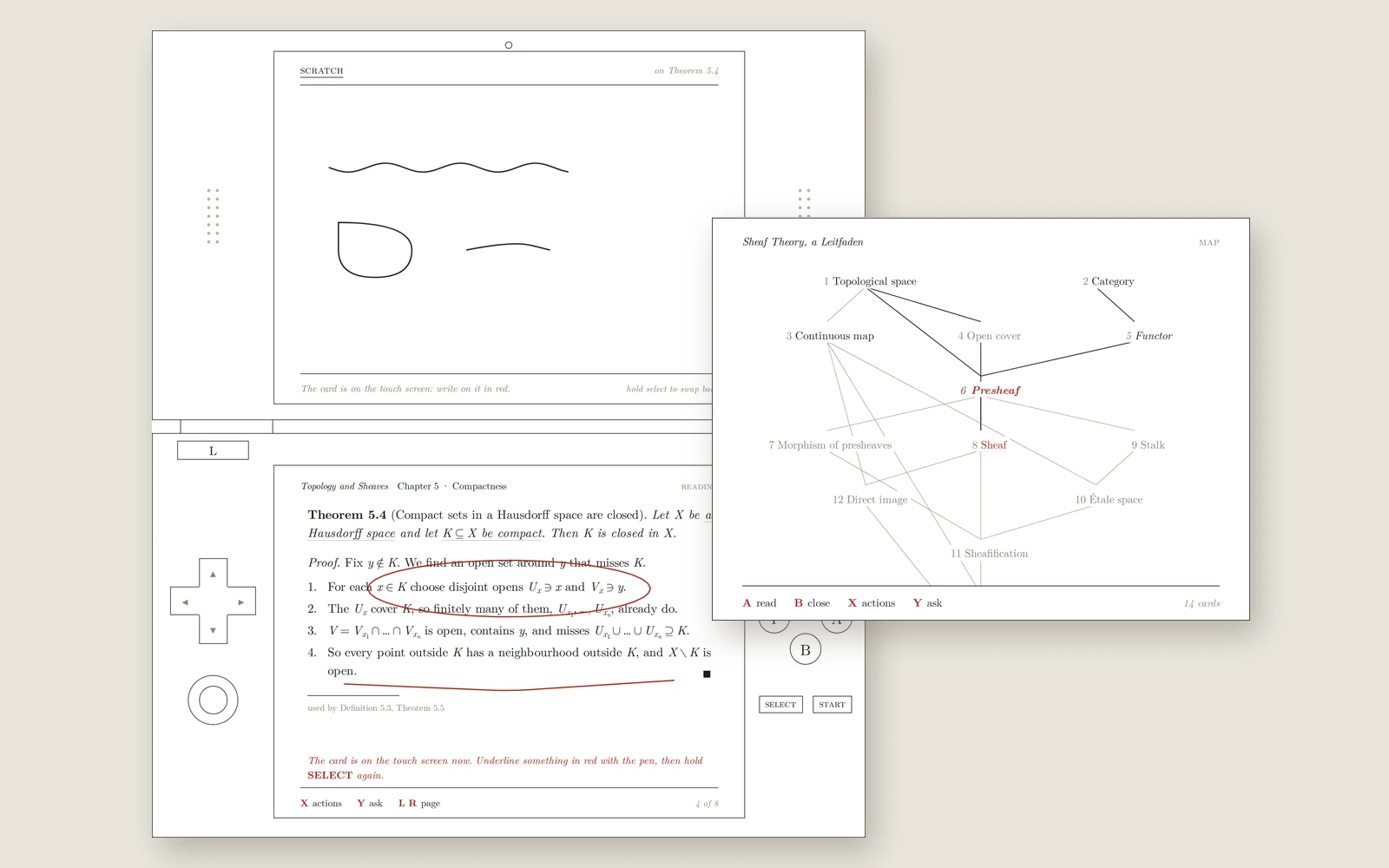
Subscribe →An IDE for reading mathematics on a two-screen handheld. Each preset is a small chapter written as card files (Markdown with TeX), a little YAML and a main.js; the editor sits beside a working model of the device, and every edit re-runs on its screens.
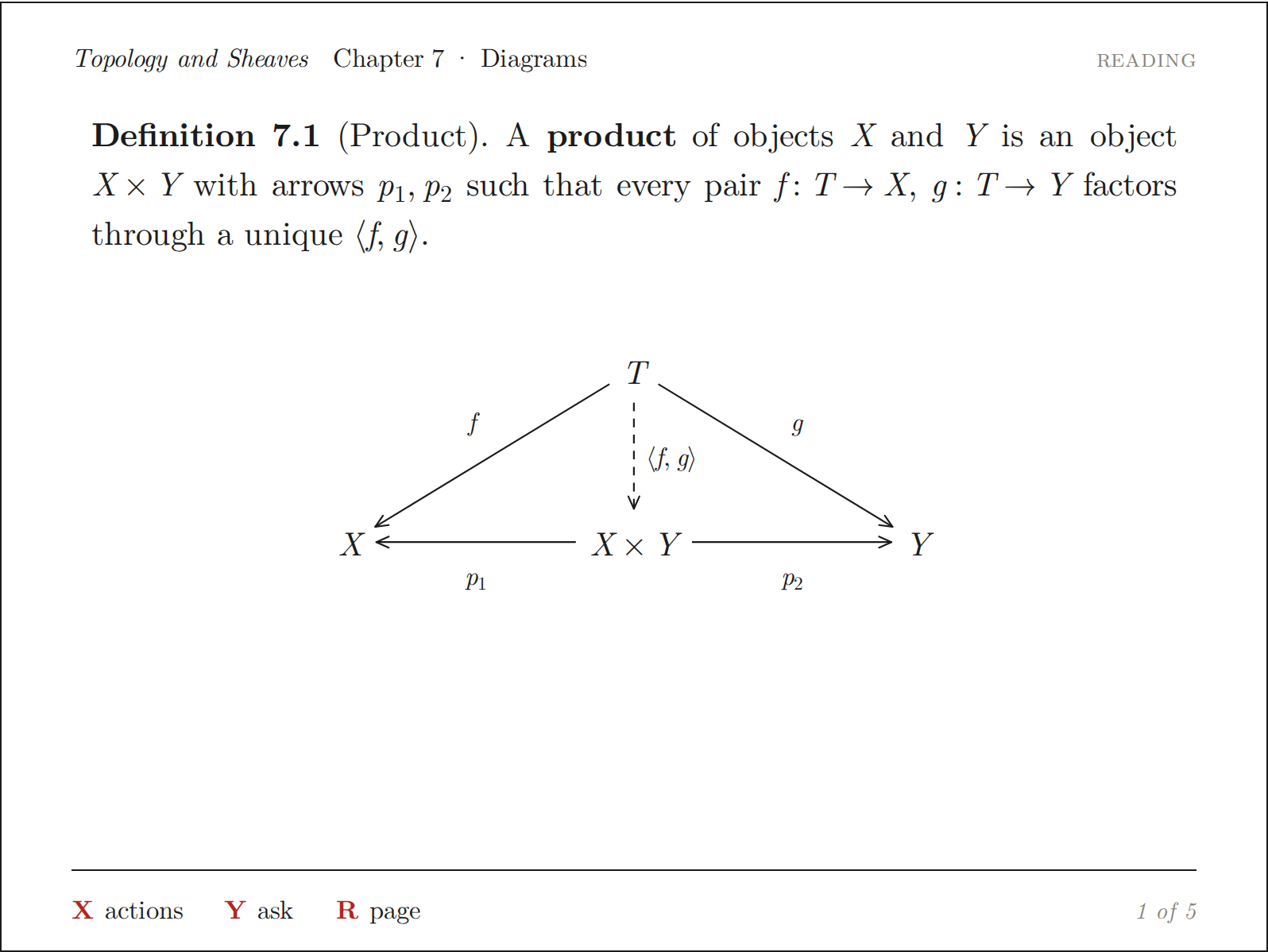
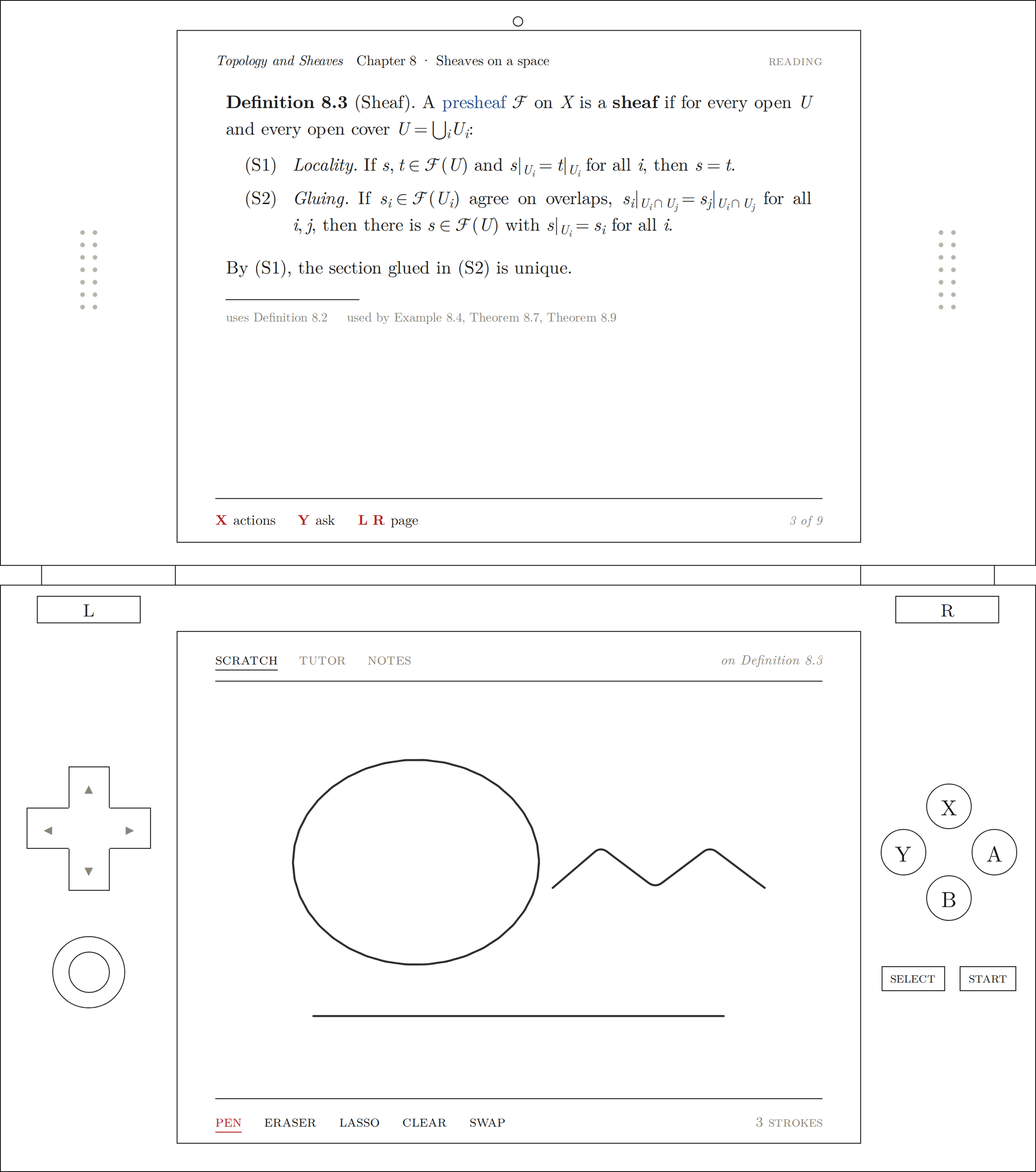
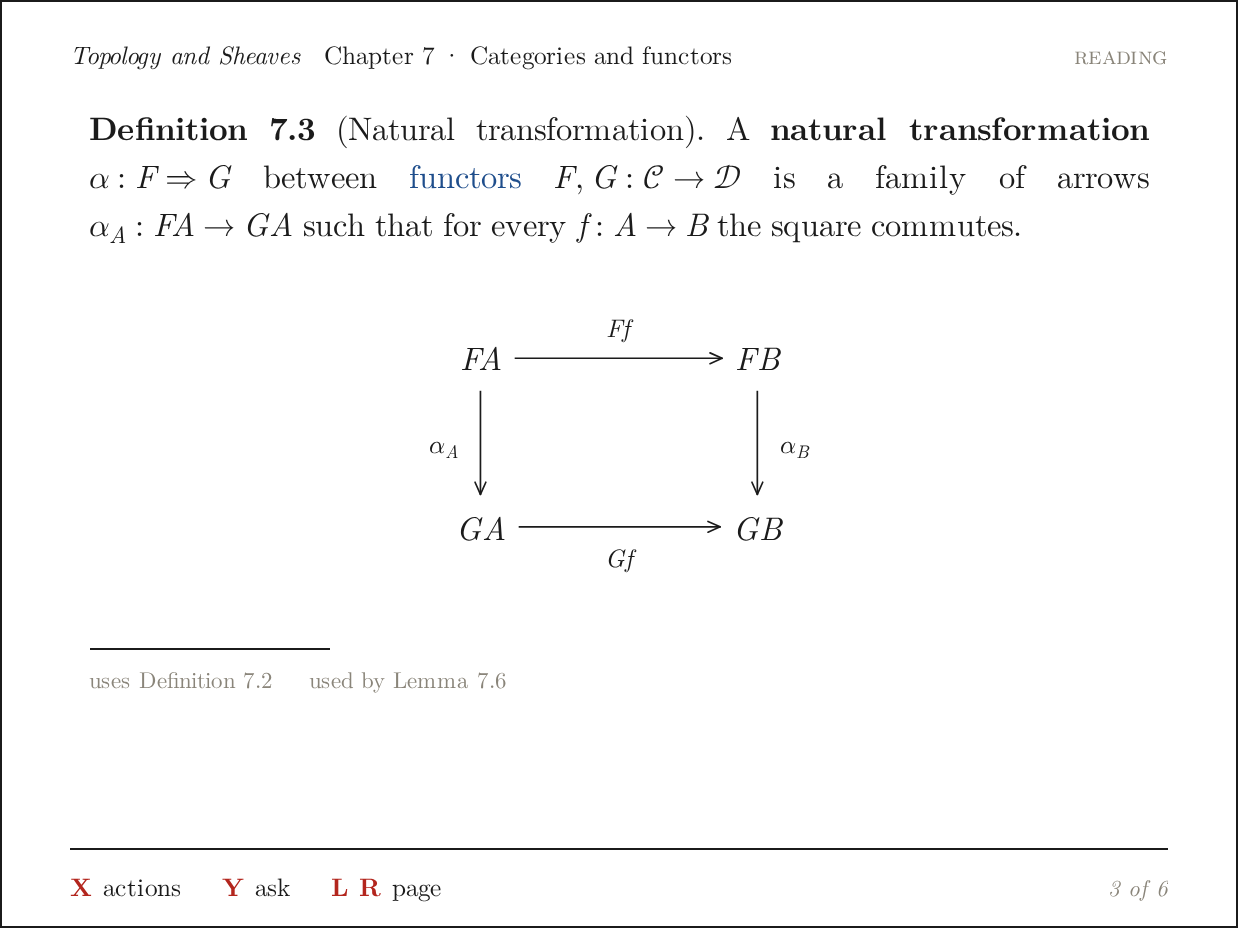
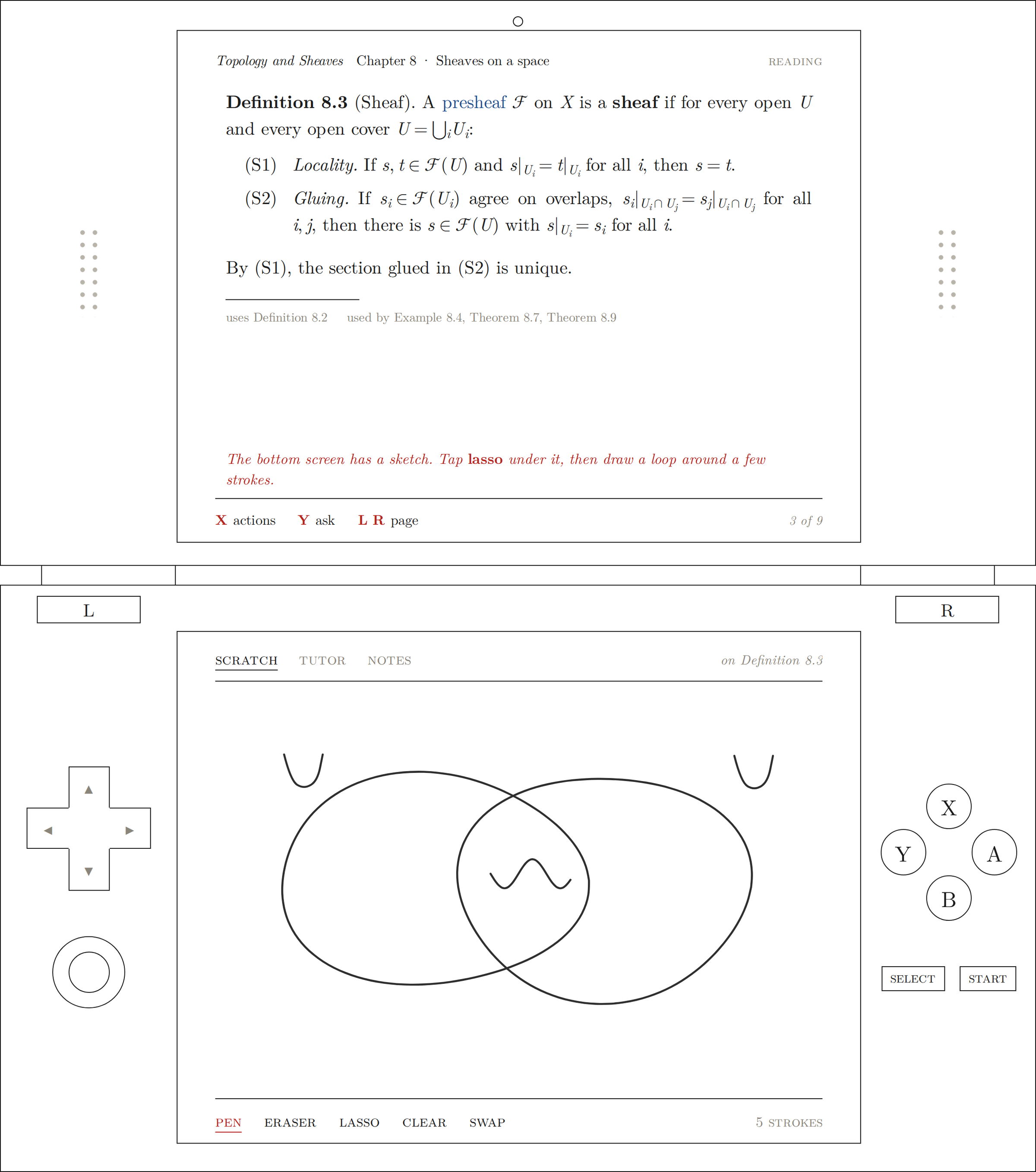
- Read on the device: definitions, theorems and proofs typeset in TeX on the top screen; turn pages with L and R, move the cursor onto a term with the D-pad and peek at it with A.
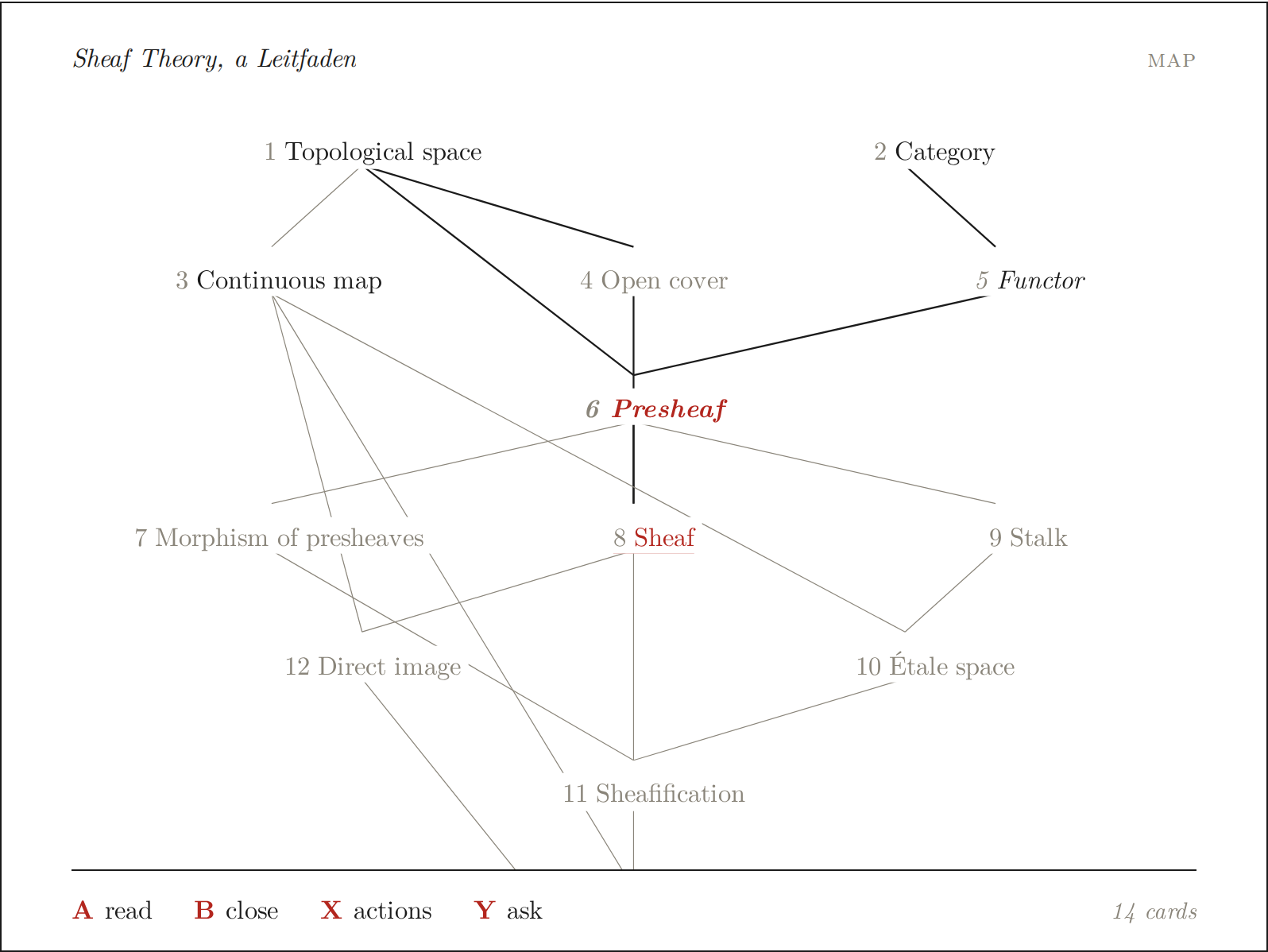
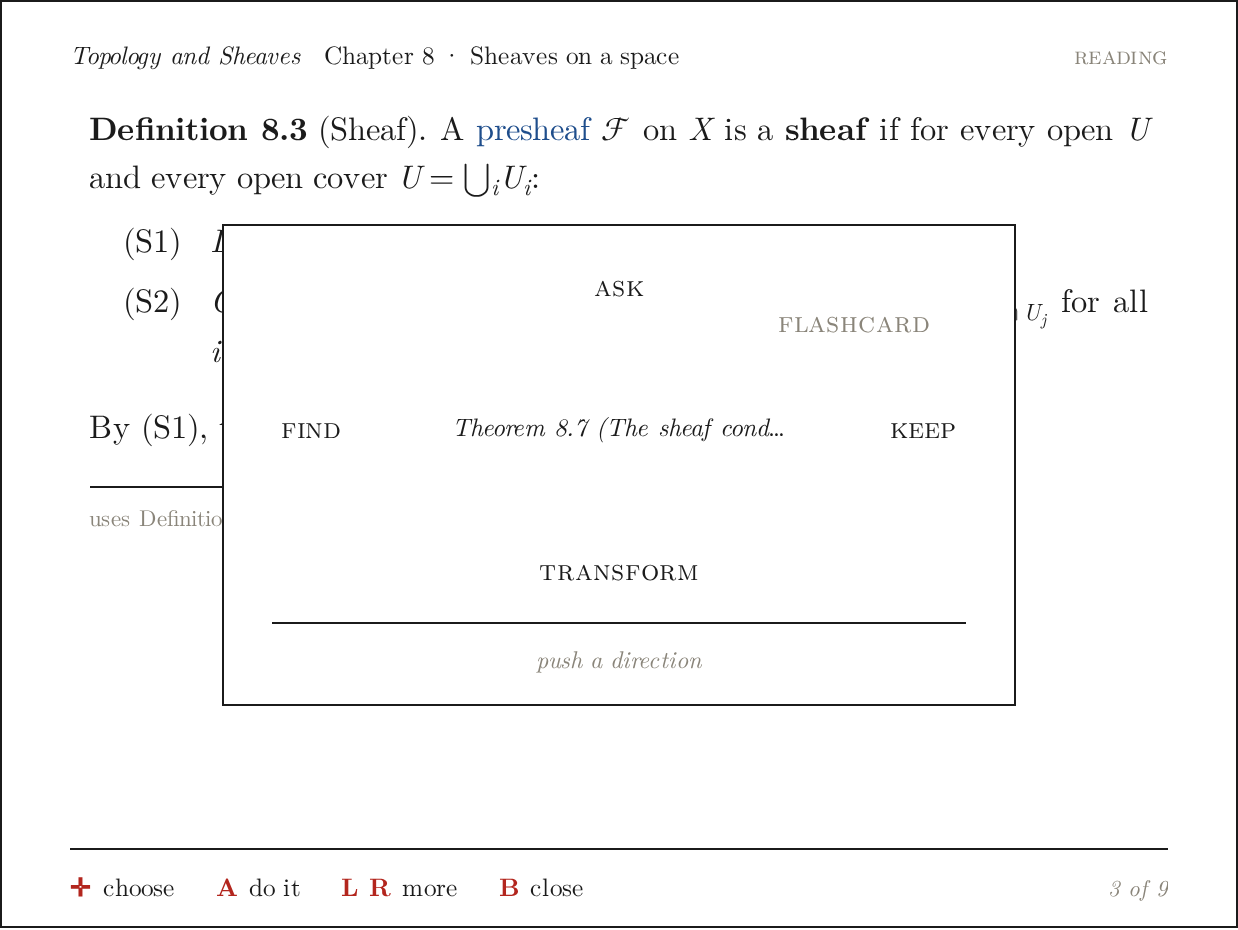
- A button grammar: X opens an action compass (ask, keep, find, transform), Y asks the tutor, L+R draws the map of the chapter, START opens the contents, SELECT switches the bottom screen between scratch, tutor and notes.
- Write your own verbs, screens and flows:
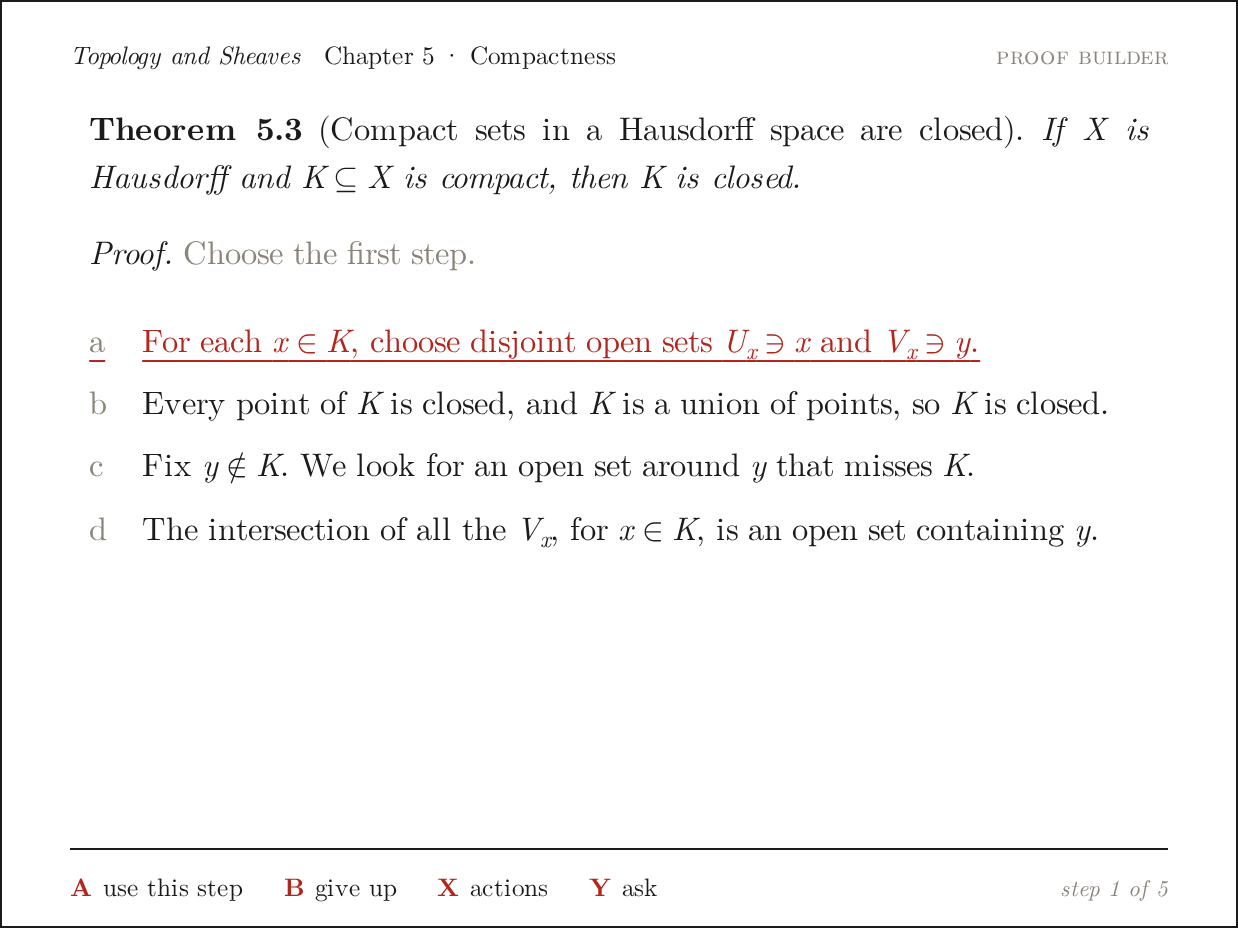
act.define,ui.viewand generator-basedflow.define, with an API sheet, an event log and an error list under the editor. - Exercises and review: quests with tiered hints, a proof builder whose wrong steps explain themselves, and a recall session graded with the D-pad.
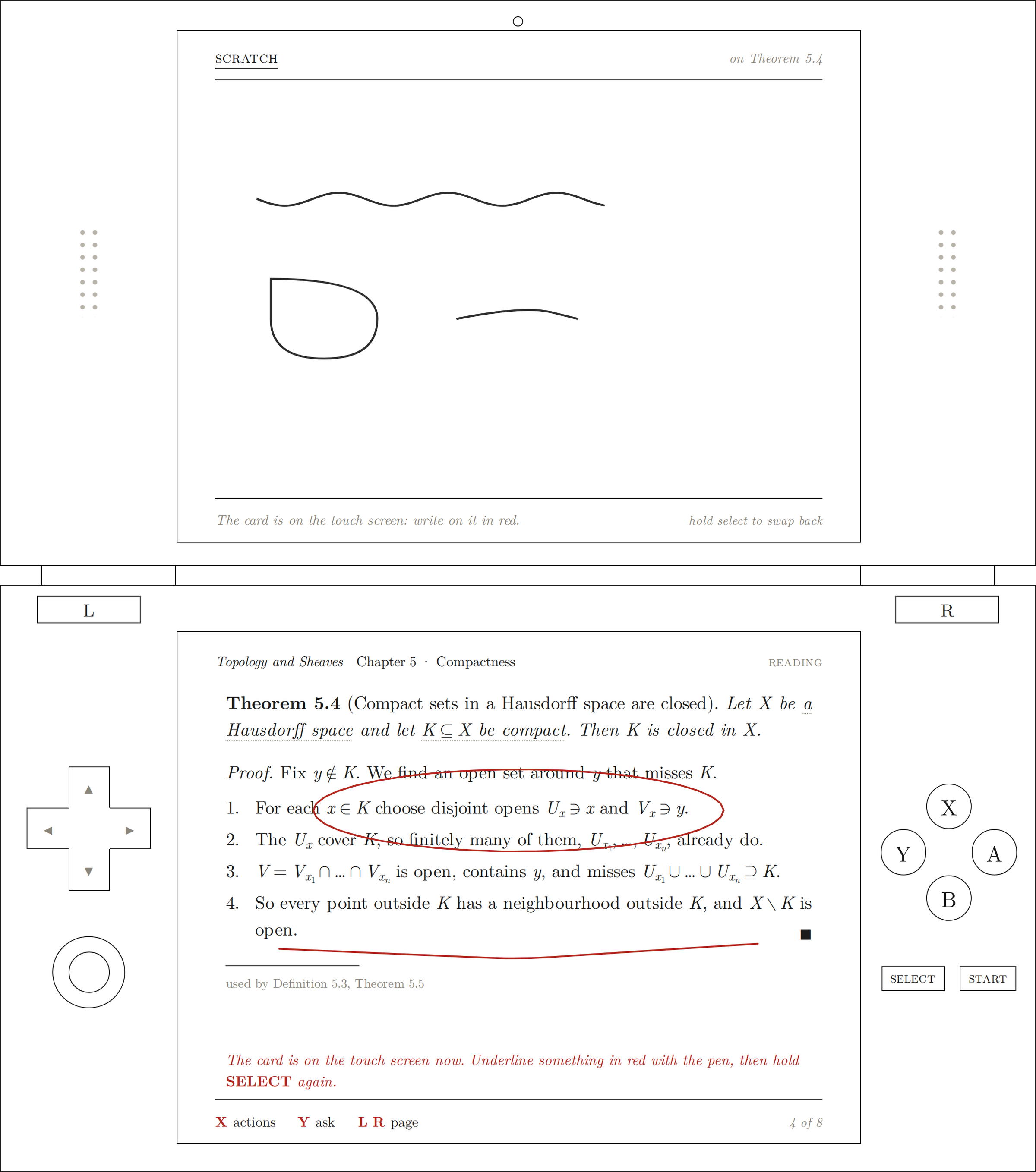
- Draw on the touch screen: a scratch page with pen, eraser and lasso, and a memo swap that moves the card down to be marked up in red.
- Tutor: when the app runs on slop.boutique, Claude answers questions about the card or term under the cursor; without it, the tutor answers from text written into the card.
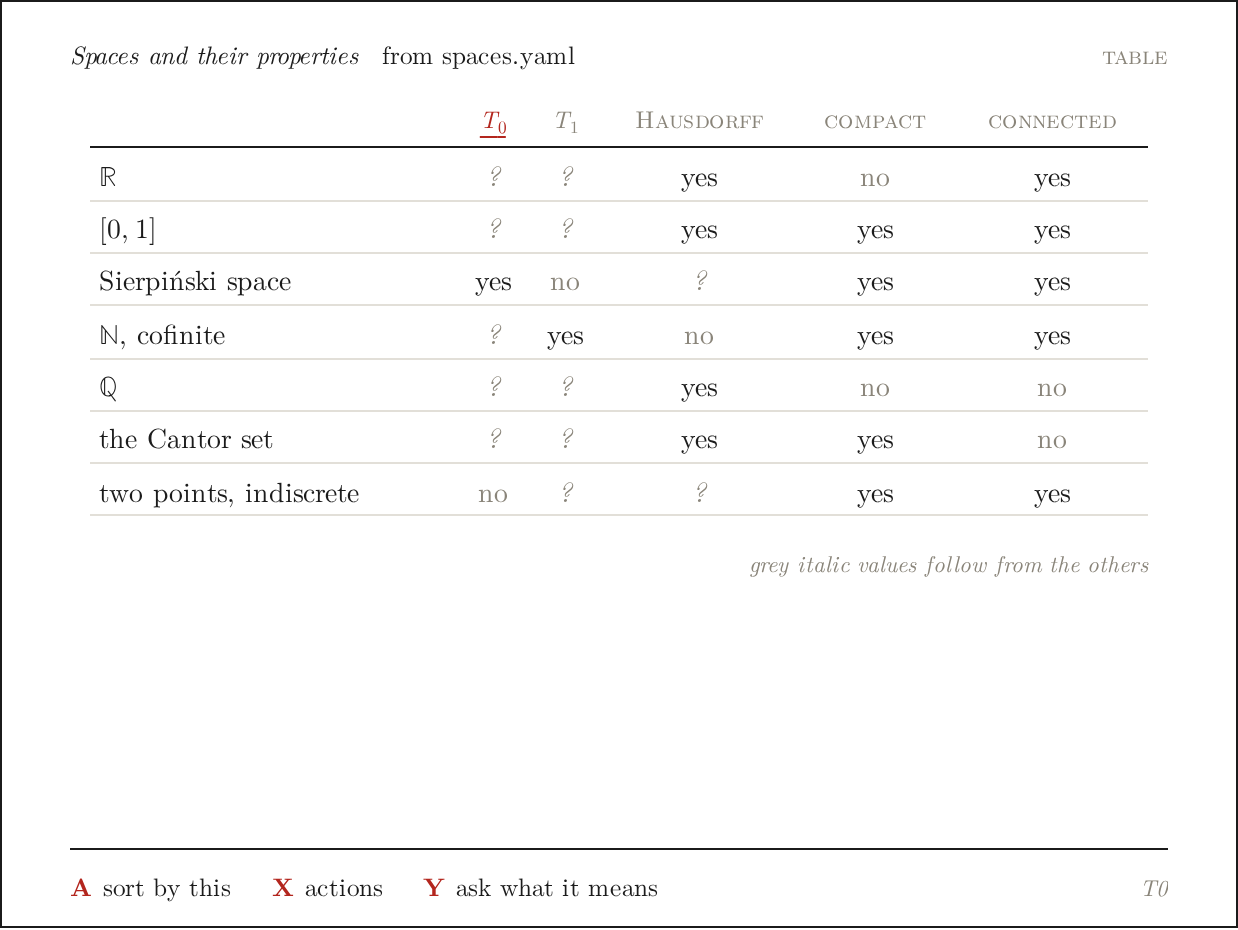
Twenty-five presets come with it, from a guided tour of the buttons and a one-card minimum to chapters on sheaves, compactness and Hausdorff spaces, separation axioms, connectedness, metric equivalence, and categories and functors, plus a Leitfaden of sheaf theory, a Finite Spaces Lab, commutative diagrams from YAML and a blank start.
Octavo Lab, also on this site, uses the same dual-screen handheld for something else: an operating-system playground with programs as QuickJS worlds, fault injection and a coding agent. Octavo IDE is the reading and study side of the device. Typeset with the Latin Modern fonts (GUST Font License), which are embedded in the page.